
Update on Temporary Foreign Worker cap increase for rural regions

Since the federal government’s announcement of a temporary increase for TFWs in rural regions from 10% to 15%, Restaurants Canada has been hard at work lobbying for our industry.
Provinces and territories have to submit a formal request to the federal government to implement the increase in eligible regions. In addition to writing to all provinces and territories urging them to activate this temporary increase, our government relations team has been in constant communications with a range of senior decision-makers to continue the push – provincial ministers responsible for immigration, Premiers’ offices, offices of other relevant ministers like Labour and Tourism, and members of provincial legislatures for affected regions.
As it stands at present, Quebec has formally declined to participate in the temporary increase. Nova Scotia has accepted the temporary increase, and we understand that New Brunswick and Newfoundland and Labrador are poised to participate as well. We know that many other provinces are actively assessing the issue and we will continue our discussions encouraging those jurisdictions to move forward on the increase.
The situation in Alberta is especially challenging with the ongoing referendum deliberations and the introduction on April 1 of Bill 26, the Immigration Oversight Act. The Bill would establish registry requirements for employers of temporary foreign workers, new licensing requirements for foreign worker recruiters and immigration consultants, and would allow the province to establish their own prohibited practices and powers to investigate contraventions. Restaurants Canada has issued a news release expressing concerns with the government’s approach and reiterating our industry’s labour needs. We are engaging with the Alberta government on the intentions of this legislation and impact on members.
Restaurants Canada also remains in constant contact with the offices of the federal ministers of Immigration and ESDC to track the status of each provincial request and coordinate our engagement. Additionally, we have an upcoming meeting with senior political staff for the Immigration Minister to further reinforce the critical labour needs of our industry.
Read our FAQ on the temporary cap increase for more information.
Many Hands Make Restaurants Work campaign underway
We are now more than a month into Restaurant Canada’s campaign, Many Hands Make Restaurants Work. The campaign targets key decision-makers, highlighting the economic importance of our industry and the systemic labour force challenges facing restaurants. The reception has been very strong, with the video having already been viewed 150,000 times. Visit ManyHandsWork.ca and share the campaign with your networks to help us drive more engagement and reach policymakers.
AGM recap and board members
Restaurants Canada had a successful 81st Annual General Meeting, and I am pleased to provide members with an update on our Board of Directors.
At the outset, I would like to thank Cindy Simpson who has completed her term on the Board. We’re grateful for her contributions and are pleased that she will continue to lend her expertise as Chair of Groupex as well as remaining on the Executive Committee. In recognition of her enormous contributions, Cindy has been nominated as an Honorary Fellow of Restaurants Canada. On a personal note, I would like to thank Cindy for her incredible support and mentorship over the years.
Special thanks and congratulations as well to Jeff Kroll whose board term has also come to an end with his retirement from McDonald’s. Of course, we wish Jeff well for his retirement, but we are not letting him go that easily. We’re thrilled to continue to benefit from his experience and leadership as he serves on the Strategic Planning Committee for Restaurants Canada and joins the Groupex Board as a Director. Jeff has been a wonderful support and mentor and I look forward to continuing to work with him for the benefit of the foodservice industry.
We are also pleased to welcome three new directors to the Board:
- Rachael Borley (Edmonton), Owner and Operations Manager, Woodwork
- Erin Legge (BC), CFO, The Keg Restaurants
- Erin Moore (BC), Chief People Officer, McDonald’s
Finally, we’re very happy to confirm that Nicolas Filiatrault will continue as Chair for a second term, serving through March 2027.
You can find the full list of the Board here: https://www.restaurantscanada.org/about-us/
Nominations for the 2026 Restaurants Canada Awards of Excellence!
Nominations for the 2026 Restaurants Canada Awards of Excellence are now open. Recognize innovators, leaders, and changemakers in your community and celebrate their impact by submitting a nomination before June 26. Nominate today
FEDERAL UPDATE
From Matt Triemstra | Vice-President, Federal Affairs
Alcohol Escalator Tax – 2% Cap Extended
On April 1, the federal government announced a two-year extension of existing excise duty relief measures for Canadian brewers, distillers, and winemakers. Effective April 1, 2026, the government will:
- Maintain the cap on annual inflation adjustments for beer, spirits, and wine excise duties at 2%.
- Continue the 50% reduction in excise duty rates on the first 15,000 hectolitres of beer produced by Canadian brewers.
Restaurants Canada has long advocated for the complete removal of an automatic escalator tax on alcohol. Any tax increase is unwelcome news and further strains the restaurant sector which is already operating on thin margins. While extending the current cap at 2% provides a better alternative to a significant hike, more must be done to provide much needed predictability and lower taxes for operators.
Restaurants Canada will continue to push both the federal government, and provincial governments, to take targeted action to reduce taxes and mark ups on alcohol. This extension sets a clear expectation that alcohol prices must remain stable across the country, allowing restaurants to offer competitive pricing to Canadian consumers during this ongoing affordability crisis.
Worker Retention Grant
The Worker Retention Grant is a new federal initiative that helps employers top up the income of workers participating in training while covered by an active and implemented Work-Sharing agreement. The Work-Sharing program supports employers during temporary downturns by providing Employment Insurance (EI) income support to employees working reduced hours. The grant enables employers with an approved and implemented Work-Sharing agreement and who commit to fostering training opportunities to provide additional income support to their EI-eligible employees who are working reduced hours and training. For more information and to confirm your eligibility, please visit: https://www.canada.ca/en/employment-social-development/services/funding/worker-retention-grant.html
SUSTAINABILITY UPDATE
From Jillian Rodak | Vice-President, Sustainability
Federal Greenwashing Provisions
On March 26, Bill C-15 received Royal Assent. This bill included proposed amendments to the greenwashing provisions in the Competition Act, which covers requirements for substantiating environmental claims about a business or product. The provisions have been adjusted by:
- Narrowing access for third parties to bring forward greenwashing claims directly to the Competition Tribunal.
- Removing requirements for companies to substantiate environmental benefit claims using internationally recognized methodologies.
Restaurants Canada participated in a consultation on the proposed greenwashing provisions in the Fall of 2024. We believe the changes above support our members’ increasing efforts to innovate and communicate about their sustainability progress.
Federal Plastics Registry – next round of consultations
Environment and Climate Change Canada (ECCC) will be hosting a series of virtual workshops to discuss stakeholder input and priorities for Phases 2 and 3 of the Federal Plastics Registry. Restaurants Canada will be participating in the workshops on behalf of our members, and we are also working on arranging meetings with senior officials at ECCC to discuss these issues in more detail beyond this stakeholder consultation process. If any members would like to participate in the ECCC workshops, click here to submit a form by April 8, 2026, to be included in upcoming workshops.
CENTRAL CANADA UPDATE
From Kris Barnier | Vice-President, Central Canada and the North
Manitoba Budget 2026 – Fighting for Fairness on Food PST
Restaurants Canada has been active in the media and has reached out directly to the Kinew Government to express our strong opposition to exempting prepared meals sold in grocery stores from PST while not committing to do the same for restaurants. We have called this measure illogical, impractical, and unfair to Manitoba consumers, workers, and restaurant operators. We will continue to aggressively fight for fairness for your businesses, employees, and patrons.
Our full overview of the Budget can be found here.
Manitoba Business Security Rebate
The Manitoba Business Security Rebate Program remains open and is still accepting claims. The program offers up to $2,500 per business location to help foodservice and other businesses repair crime-related property damage and invest in eligible security measures. There is no cap on the number of locations per applicant. Program details and application information are available here.
Ontario Budget
Restaurants Canada President and CEO Kelly Higginson and VP for Central Canada Kris Barnier were invited guests of Finance Minister Peter Bethlenfalvy as he delivered Ontario’s 2026 Budget in the Legislature. The Budget did include a welcome measure to reduce the Ontario small business tax rate from 3.2% to 2.2% on the first $500,000 of taxable income there was no movement on alcohol pricing.
The unfairness for restaurants on beer pricing by major brewers continues, with grocery and convenience stores receiving preferential treatment in the range 30% over restaurants in Ontario. This is an issue we are continuing to push aggressively with the government, building on recent positive discussions with the Premier who is very sympathetic to correcting this unfairness to our sector.
As members know, the LCBO’s new wholesale pricing structure came into effect on April 1. It is our understanding that, in general, prices decreased slightly or remained relatively flat for spirits and decreased further for cider and ready-to-drink beverages. For wine, it appears that lower priced products declined slightly, while higher-priced wines have increased in price. We welcome any feedback you can share regarding how the new LCBO service model and pricing approach are impacting your business.
Our Budget recap can be found here.
Connecting with Ontario Premier Ford and the Red Tape Reduction Minister
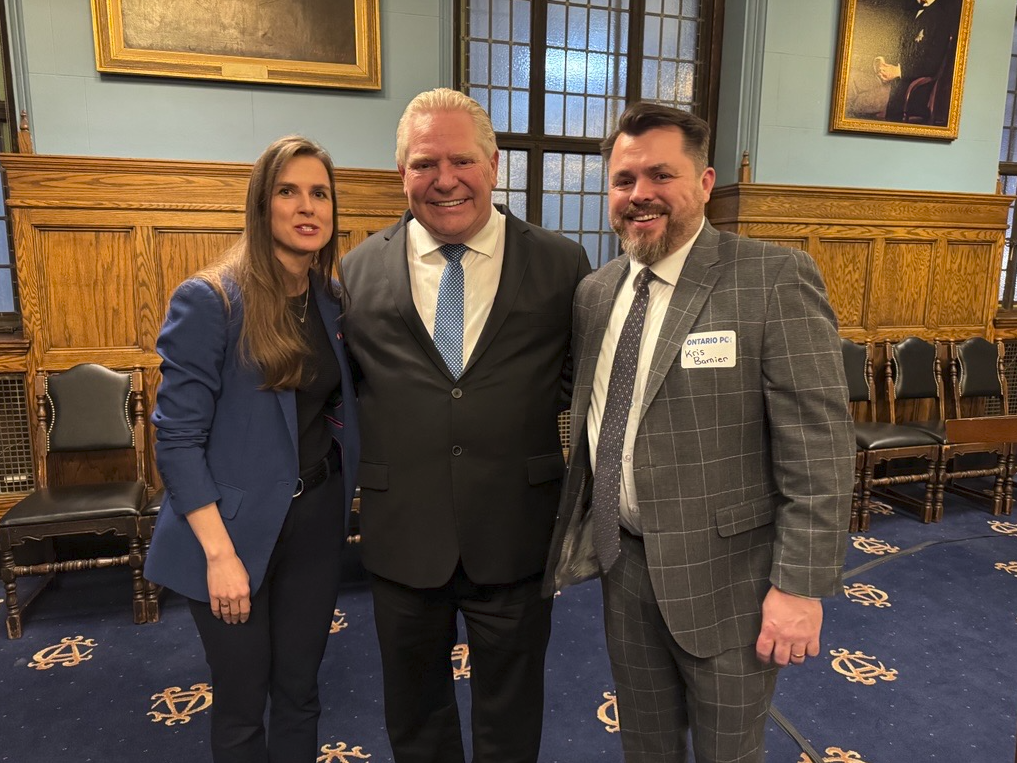
Restaurants Canada connected with Red Tape Reduction Minister Andrea Khanjin and Premier Doug Ford at a recent event in Toronto. We spoke with the Minister about Ontario’s Healthy Menu Act and how it creates unique costs and requirements for restaurants to print calorie counts on menus. We expect to meet with the Minister in the coming weeks to discuss this matter in greater detail.
We also had a productive conversation with the Premier about challenges facing the restaurant industry.
Toronto CaféTO Grants
The CaféTO Grant is available to commercial and industrial property owners and tenants in Toronto to improve the appearance and/or function of curb lane cafés, commercial patios, and sidewalk cafés. Applications are being accepted until 4 p.m. on Thursday, May 7, or until all the grant funding has been expended. Click here for more information.
WESTERN CANADA UPDATE
From Cheryl Maitland Muir | Vice-President, Western Canada
British Columbia LCRB licence renewal fee increase
The Liquor and Cannabis Regulation Branch (LCRB) has announced that annual liquor licence renewal fees will increase 30% effective May 1, 2026. This is the first update to renewal fees in more than 15 years and is intended to support modernized, self-sustaining licensing services.
Restaurants Canada recognizes this increase represents another added cost for B.C. restaurants, at a time when you are already facing intense financial pressure. Later this month we are meeting with Minister Popham and will continue to highlight how rising operating costs, many of them government driven, are undermining restaurants’ profitability. Visit LCRB for more information.
Alberta: Food inspection update
The Alberta Health Ministry’s public engagement on the proposed food safety inspection grading system and the food safety culture excellence recognition program is now closed. We continue to speak with key government decision makers on the problems with the government’s proposed approach that do not ultimately benefit public health. Our concerns are being well received, and we will continue to update you as discussions progress.
This month, Restaurants Canada will be attending the AGLC’s Safer Bars Council meeting as well as the Premier’s Summit on Fairness for Newcomers, both of which will provide opportunities to meet with decision makers and advocate on behalf of Alberta restaurants.
Saskatchewan
Restaurants Canada will be attending the Saskatchewan Food and Beverage Expo in Regina at the end of April. We will be planning member engagement opportunities and look forward to seeing you then!
With gratitude,

Kelly Higginson
